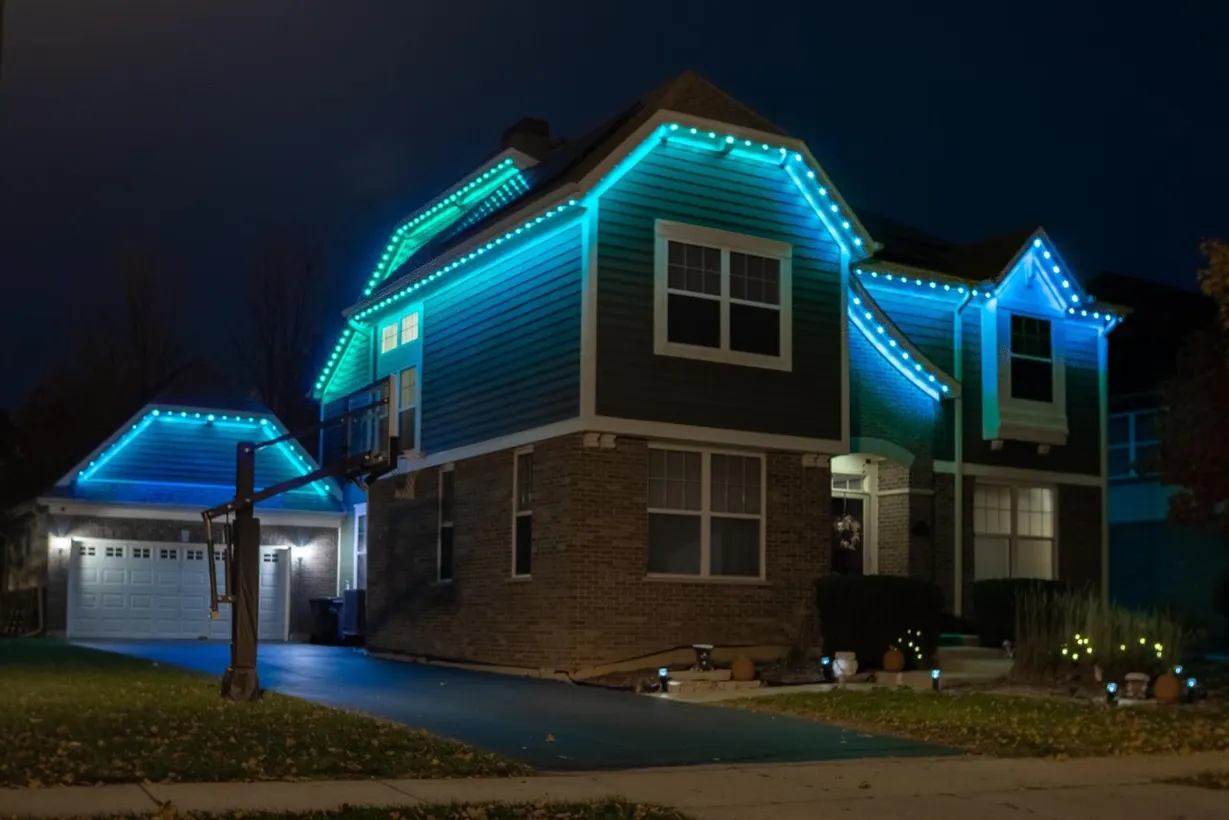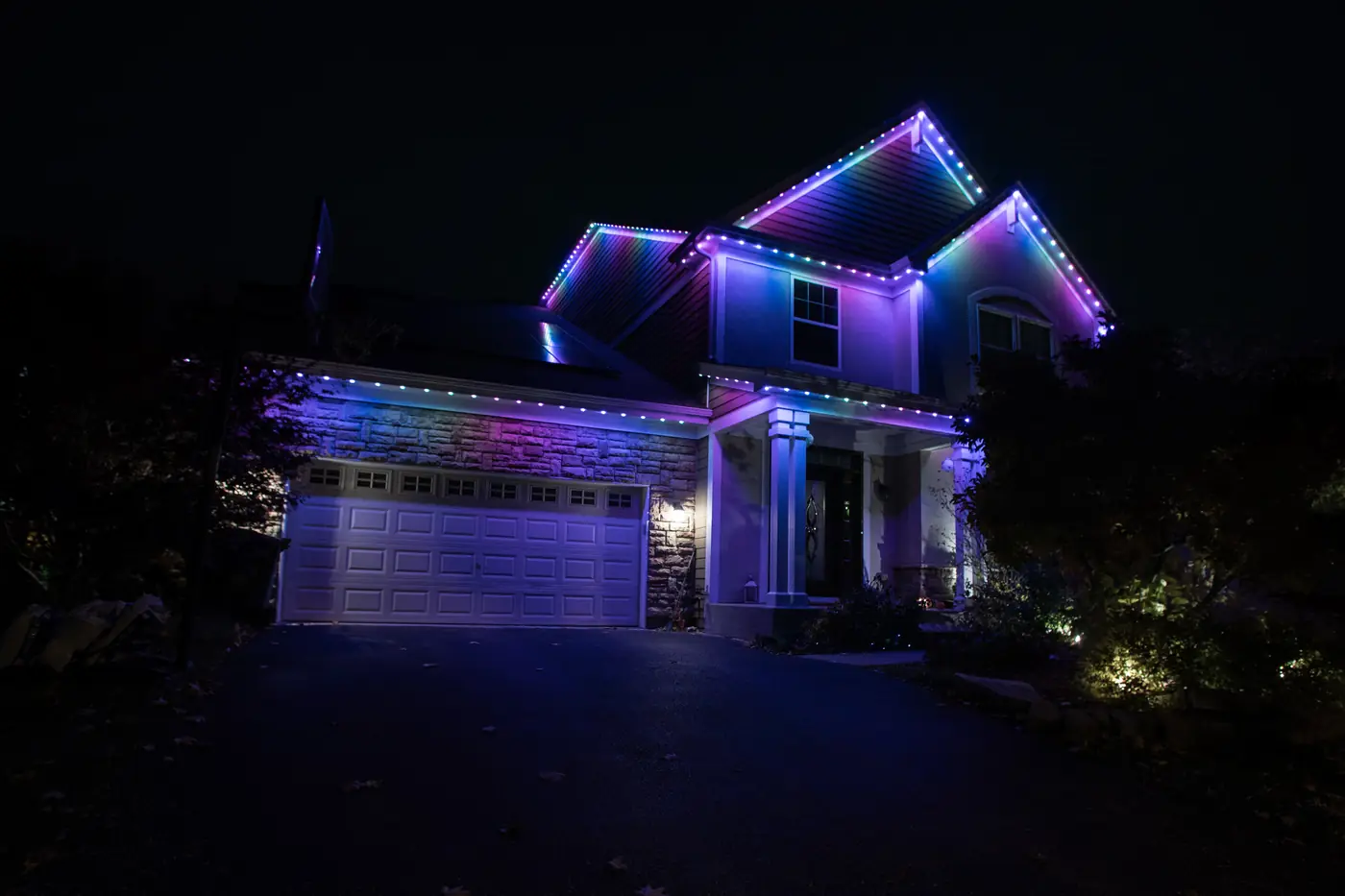
Permanent outdoor lighting can look almost identical in a nighttime video and completely different after five Chicago winters.
The differences are usually hidden in the parts homeowners do not see first: the white-light diode, data wiring, voltage design, track material, connectors, power placement, warranty labor, and the installer who has to service it later.
Hanging Lights Club installs Minleon permanent lighting, so we want to be clear about our perspective. We recommend it because it fits the kind of professional, serviceable system we want to support. Gemstone Lights is also a top-tier professional product, and on a couple of specific measures it beats Minleon outright. Other brands may be a better fit for a homeowner who prioritizes a specific app, dealer network, DIY installation, or lower initial price.
Here is how the major permanent-lighting systems compare.
The Short Answer
If you want the quick version:
A low kit price does not include the same product as a complete professional installation. Compare the lights, track, fasteners, electrical planning, app setup, warranty labor, and service support together.
Three Different Products, Not One Category
These systems get grouped together. They should not be.
Professional, track-integrated systems — Minleon, Gemstone, Trimlight, JellyFish, Celebright. Lights sit inside a mechanically fastened, color-matched track. Wiring is concealed. Sold and serviced through installers.
Professional or advanced DIY systems — Oelo, EverLights ClickLights. Available installed or as serious DIY kits with real channel and controller hardware.
Consumer DIY puck-string systems — Govee Pro, Govee 2, Eufy E22. A cable with pucks on it, mounted with adhesive and clips. Excellent apps, very low hardware cost, no fitted track in the box.
The third group is not a cheaper version of the first. It is a different product.
Permanent-Lighting Brand Comparison
| Brand | Best fit | Dedicated white diode | Mounting system | Typical public pricing* | Main trade-off |
|---|---|---|---|---|---|
| Minleon RGBW+ | Premium professional installation | Yes — R-G-B-W channels | Color-matched UV-coated PVC track, screw-fastened | Custom installed quote | Basic app; PVC rather than aluminum track |
| Gemstone Lights | Premium professional installation | Yes — 3 packages, 12 diodes per light | Color-matched aluminum track | Common dealer range: $20 to $35 per foot | Premium price; app capped at 10 timers |
| Trimlight | Established dealer network | No dedicated white on current Classic/3L specifications | Color-matched aluminum channel | Trimlight publishes $18 to $35 per foot | White is created by mixing RGB |
| JellyFish Lighting | High-voltage professional system | No, white presets mix RGB | Low-profile color-matched track | Common market range: $25 to $35 per foot | Five-year parts and one-year labor coverage |
| Oelo | Professional or advanced DIY | No dedicated white documented on the core multicolor system | Aluminum or UV-stable acrylic channel | Independent sources: about $1,340 for 50 ft DIY, $3,350 for 150 ft DIY | High fixed hardware cost, especially on small projects |
| EverLights ClickLights | Flexible professional or DIY path | Yes — "True Warm White" | Multiple channel colors and orientations | Third-party estimates around $16 per foot DIY or $20 to $30 installed | Product generation and warranty must be confirmed carefully |
| Celebright | Premium track and architectural white | Yes | Aluminum track | Dealer comparisons often cite $18 to $28 per foot | Smaller U.S. dealer footprint and limited independent long-term data |
| Govee Pro | App-focused DIY buyer | Yes, 2700K to 6500K | Adhesive and screw clips, no fitted track in base kit | $599.99 | Visible string unless separate track is added |
| Govee Outdoor Lights 2 | Lowest-cost DIY | Yes, 4000K | Adhesive and clips | About $200 to $330 | Not cuttable; 16.4-inch spacing |
| Eufy E22 | Bright DIY wall-wash effect | Yes, 1500K to 9000K | Adhesive plus screw hole | $199.99 to $489.99 for 50 to 150 feet | Not the same daytime finish as a fitted professional track |
Pricing changes by footage, spacing, height, roofline complexity, power, track, warranty, region, and seasonal demand. Public ranges are not quotes.
Why We Install Minleon
We chose Minleon for six practical reasons.
1. Real white light from a dedicated diode
Minleon's RGBW+ Pebble uses R-G-B-W LED channels — a dedicated white diode rather than white produced by blending red, green, and blue. Minleon's own data sheets list the white variant's channels as "R-G-B-W," and its 24-volt sheet offers an "R-G-B-WW" warm-white configuration.
That matters because most homeowners will use white far more often than animated holiday patterns.
RGB-only systems create white by combining red, green, and blue. The result may look cool or slightly tinted. A dedicated white diode produces a more natural architectural look for everyday evenings, weddings, quiet holidays, and landscape accents.
One honest note: Minleon does not publish a Kelvin rating for its white. We will show you a lit sample in person. We are not going to quote you a color temperature the manufacturer has not published.
2. Redundant data
Addressable lights pass control data from one light to the next. On a basic single-data system, one failed node can interrupt the lights downstream.
Minleon's four-wire Pebbles include a second data line. The company's own product page describes a "double data line (so one bad pixel will not compromise the rest of the string)." That redundancy is designed to keep the remaining run communicating if one node develops a problem. It does not make the system impossible to damage, but it reduces one common failure mode.
Worth saying plainly: this is not unique to Minleon. JellyFish publishes redundant data too, describing its run as "power, communication, redundant data, ground." Redundant data marks the professional tier. Consumer puck strings generally do not have it.
3. Modular, weatherproof sections — no cutting, no splicing
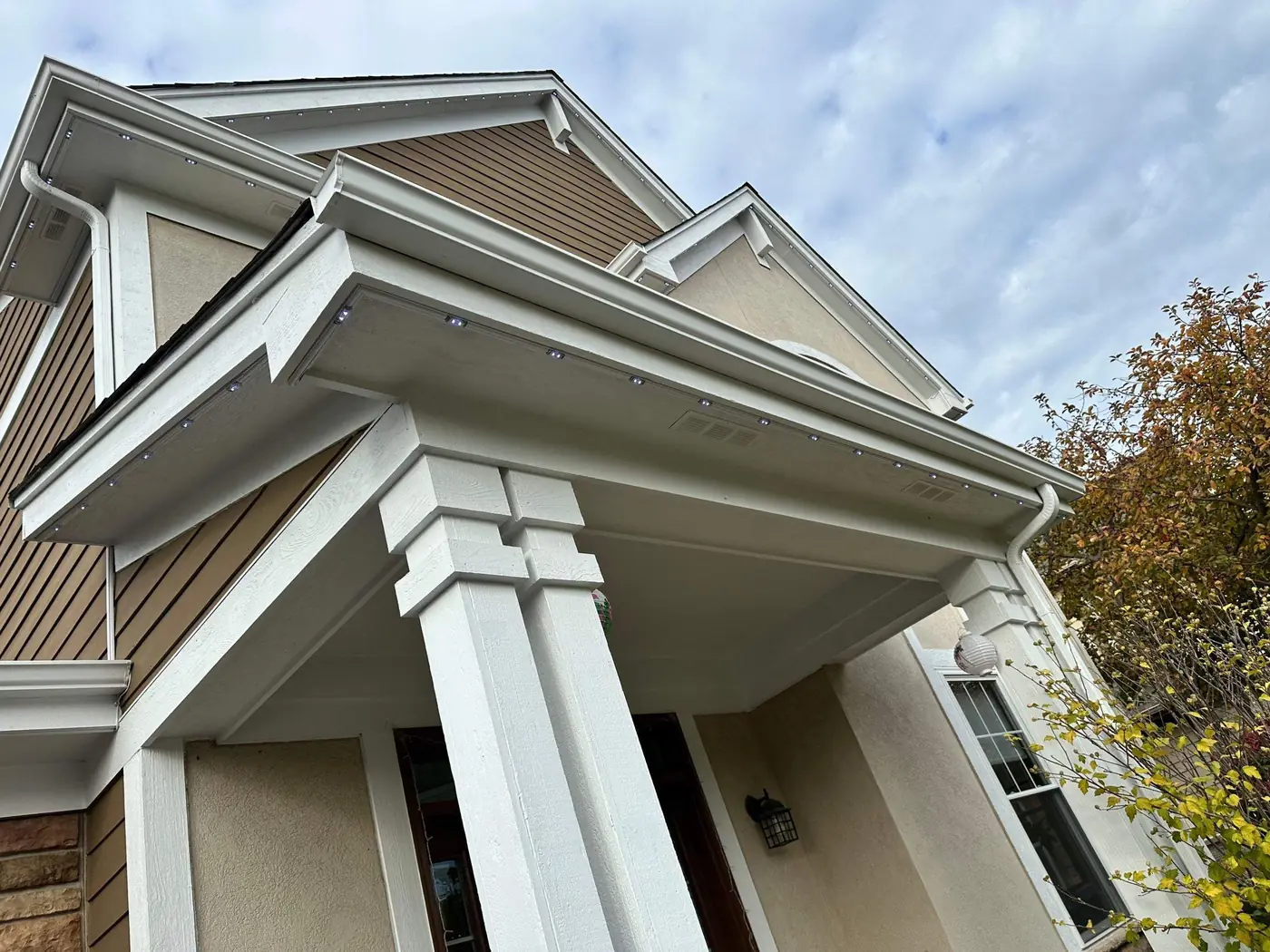
Minleon supplies factory-made 1, 2, 5, 10, and 25-light sections joined by LLT twist-lock weatherproof connectors. The strings are not cuttable, and HLC does not splice Minleon light strings. Every connection on our installations is a factory-terminated joint that clicks together.
The practical result: we never introduce a field splice, so we never introduce a new place for water to get in. Minleon's own terms also void the warranty on any product altered without its written authorization — a second, separate reason not to improvise on a roofline.
If a light develops a problem, the technician removes the covers and changes the connected factory section through its factory connectors.
You may see installers claim online that splicing "voids the UL listing." We have not found any UL or Minleon document that says so, so we are not going to repeat it. The moisture argument and the warranty language stand on their own.
4. One matched component ecosystem
Minleon's lights, connectors, controllers, power supplies, track, and app are designed and sold as one Minleon-Rainmin ecosystem rather than assembled from unrelated suppliers. That gives the system consistent electronics and matched components, and it gives HLC one product ecosystem to stock, diagnose, and support.
We are not going to claim anything about how our competitors organize their manufacturing. We do not have that information and neither does anyone quoting it at you.
5. Smooth wall wash
In our installations, a frosted Pebble mounted inside the track throws a smoother wash across the wall than an exposed puck aimed at it — noticeably so in white, and smoother during color effects.
That is our field observation, not a published manufacturer specification. Ask to see it at night on a real house before you take anyone's word for it, including ours.
6. A system we can support
The app matters, but it is only one part of the ownership experience. We want a system we can design, stock, diagnose, and repair after the installation.
Because sections unplug, a failed section is a swap rather than a rebuild of the run. Where the design called for a one-light section, that single light is genuinely replaceable on its own.
With HLC, the scope includes track planning, mechanical fastening, wire concealment, power design, controller setup, customer training, testing, and local service. The goal is not to install lights and disappear.
Can Individual Minleon Lights Be Selected or Replaced?
This is where marketing across the whole industry gets sloppy, so let us be precise. Three different things get blurred together.
1. Individually addressable. The hardware can drive every light separately. Minleon Pebbles are individually addressable — Minleon's data sheets say so directly. So are Gemstone, Trimlight, JellyFish, EverLights, and Oelo lights.
2. Individually selectable in the app. Whether the app lets you tap one specific light and paint it a color. This is a software question, and the answer differs by brand.
3. Physically replaceable as one node. Whether a technician can remove one light without replacing a longer section. This is a hardware question, and the answer differs again.
Here is where Minleon sits on each.
Addressable: yes.
Selectable in the app: not the way people imagine. The Pixel Dancer app that runs Minleon's WEC3 controllers works by palette and pattern. You choose up to six colors, choose an effect, and set a spacing value that decides which color lands on which light. It is genuinely capable — you can build a candy-cane alternation, a team pattern, or a two-color chase. What it is not is a canvas where you tap Pebble number 47 and turn it purple. Free-hand per-pixel control on Minleon exists, but it lives on the professional NDB+ controller path with Art-Net sequencing software — different hardware, and not what a homeowner drives from a phone.
Gemstone publishes the opposite: its system supports addressing each light individually through the Hub app. If tapping one specific light on your phone is what you care most about, that is a real reason to look at Gemstone rather than us.
Replaceable as one node: only by design. Minleon uses fixed factory sections that are not cuttable. A one-light section can be replaced individually where one was used in the layout. A failed node inside a longer factory section is handled as a section-level repair. The redundant data line can allow the remaining lights to continue working while the affected section is scheduled for service.
Ask every brand all three questions. "Individually controllable" in a sales conversation can mean any of them.
How Much Electricity Do Permanent Lights Use?
Short answer: almost none, and it is not a reason to pick one brand over another.
Here is what each manufacturer actually publishes. Minleon is one of the few that publishes a real per-light figure on a data sheet.
| System | Published draw | Source type | Watts per 100 ft of roofline |
|---|---|---|---|
| Minleon RGB+2 Pebble | 0.36 W per bulb, 0.015 A at 24 VDC | Manufacturer data sheet | ~36 W (100 lights at 12-inch spacing) |
| Minleon RGBW+ 4-LED Pebble | 0.53 W per bulb, 0.022 A at 24 VDC | Manufacturer data sheet | ~53 W (100 lights at 12-inch spacing) |
| Gemstone | 1 W per bulb at maximum | Product page | ~100 W |
| Celebright | "less energy than a single 60W bulb for 100 lights" | FAQ | under 60 W |
| Govee Pro | 100 W power supply | Adapter rating, not consumption | up to 100 W (60 lights per 100 ft) |
| Eufy E22 | 72 W power supply | Adapter rating, not consumption | up to 72 W (60 lights per 100 ft) |
| Trimlight, JellyFish, Oelo, EverLights | Not published | — | Unknown |
What that costs. Call it roughly 17 cents per kilowatt-hour all-in. ComEd's January 2026 residential supply rate was 9.66 cents, plus a 6.228-cent distribution facilities charge for a single-family home on non-electric heat, before transmission and riders (Citizens Utility Board, January 19, 2026).
At that rate, running 200 feet of Minleon RGBW+ at full brightness with every channel lit, six hours a night, every night of the year works out to about $39 a year. Nobody runs it that way. In everyday white at a normal brightness setting, our estimate is closer to $12 to $16 a year.
On a consistent basis — a 100-foot roofline, same six hours a night — every brand here that publishes a number lands between roughly $13 and $40 a year. Double the footage and both ends roughly double.
Is Minleon the most efficient? On published per-light draw, Minleon is at the low end of everything we could verify — 0.36 to 0.53 watts per bulb. We are not going to sell that as a win, for four honest reasons:
Efficiency is fine to mention. It is not a reason to choose a system, and any installer leading with it is avoiding a harder question.
Is Minleon 12 Volt or 24 Volt?
24 volts. Every current Minleon permanent-lighting data sheet — the RGB+2 DoubleDATA Pebble, the RGBW+ 4-LED Pebble, and the 24 VDC 2-LED Pebble — lists an input voltage of 24 VDC, and the product carries a 24 VDC badge.
Minleon does build 12-volt Pebbles, and they exist in the wider catalog. The permanent roofline product we install is the 24-volt version.
The reason matters more than the number. Voltage drop over a long run is what makes far-end lights shift pink, flicker, or refuse to hold white. A 24-volt system tolerates roughly twice the run length of a 12-volt system before that happens, which means fewer power supplies, fewer injection points, and fewer places for something to go wrong on a large roofline.
Minleon's data sheets put the practical ceiling at about 160 lights or 160 feet before power injection is required on the RGBW+ 4-LED product, and about 200 lights or 220 feet on the RGB+2. Past that, a properly designed system adds a power injection point. On most Palatine two-story homes, that calculation is what decides how many power supplies your install needs — and it is the kind of thing that gets skipped on a cheap bid and shows up as pink lights at the far corner three years later.
Minleon vs. Gemstone Lights
Gemstone Lights is the strongest direct comparison for many premium homeowners, and we are not going to pretend otherwise.
Where both systems are strong
Where Minleon fits our work
Where Gemstone is genuinely stronger
Gemstone's own limits are documented too: the Hub1 app is capped at ten timers, users report crashes when cycling through pattern previews, and Gemstone has announced a Hub2 controller while acknowledging Hub1 reached its technical ceiling. And beyond the first year, Gemstone notes that service charges may apply — so the local dealer agreement still matters.
Our honest view: Minleon and Gemstone are both top-tier systems. We install Minleon because the no-splice architecture, section-level serviceability, redundant data, dedicated white diode, and matched 24-volt component ecosystem match how we want to build and support a system for ten years. If a polished app and per-light control in your hand are your top priorities, look hard at Gemstone.
How the Other Professional Brands Compare
Trimlight
Trimlight has one of the best-known dealer networks in permanent roofline lighting. Its aluminum channel is mechanically installed and color matched to the home. Current Classic and 3L product pages describe RGB systems, which means white is created by mixing colors rather than using a dedicated white diode.
Trimlight is also the only major brand that publishes its own pricing: $18 to $35 per linear foot, with example project bands from $2,500 for a small front elevation to $14,500 for all sides of a larger home.
Read the warranty carefully. "Lifetime" is defined as "the manufacturers estimated lifespan of the parts," which Trimlight puts at 20 to 30 years in average use. Labor is covered for a minimum of one year. And a minimum $75 service fee may be charged if the parts are shown to work. Wi-Fi and RF interference, weather, animal damage, and fading are excluded.
Best for: homeowners who value an established dealer brand, app features, and a recognizable track system.
Watch for: RGB-mixed white, the service fee, Wi-Fi exclusions, and the local dealer's labor terms.
JellyFish Lighting
JellyFish uses a 48-volt, four-wire system with three LEDs per light and spacing options at 6, 9, or 16 inches. Its track is compact at 3/4 inch by 1 1/4 inch and color matched. The four-wire run carries "power, communication, redundant data, ground," and one controller supports up to 250 feet of lights. The system is UL certified and ETL listed, runs on 2.4 GHz Wi-Fi, and per JellyFish "also works without WiFi."
The official product pages describe RGB lights that create white presets by mixing colors, not an RGBW diode. Published coverage is five years on parts and one year on labor.
Best for: homeowners who want a high-voltage professional system with redundant data and flexible spacing.
Watch for: mixed white instead of dedicated warm white, shorter product coverage than Gemstone or Trimlight, and local dealer dependence.
Celebright
Celebright has excellent specifications on paper: 24-volt RGBW lights with a dedicated white diode, compact 20 mm frosted bulbs, aluminum track, and a clean certification story — ETL listed under number 5023546, conforming to UL 2108 and CSA C22.2 #250.2. Bulbs are rated 50,000 hours and are replaceable through Celebright.
Control runs through Celebright Cloud, with Google, Alexa, and IFTTT support. Note the name: it is a cloud-connected platform.
Best for: homeowners prioritizing architectural white, many track profiles, and a clean professional finish.
Watch for: a smaller U.S. service footprint — head office is in Ottawa — and confirm the local dealer's warranty, labor, and service-call terms in writing.
Oelo
Oelo sells both professional and advanced DIY systems. Its aluminum and UV-stable acrylic channel options create a finished daytime appearance, they can face out or down, and the company publishes an unusually long 100,000-hour LED rating.
Published warranty terms run seven years on authorized dealer installations and five years for contractor and DIY installs. Independent sources put DIY kits around $1,340 for 50 feet and $3,350 for 150 feet, which works out above $23 per foot before labor.
One caveat we will state plainly: oelo.com blocked our automated checks on every attempt, so unlike every other brand here, we could not re-verify Oelo's warranty or pricing against the company's own live pages. Treat both figures as unconfirmed and get them from Oelo in writing.
Best for: homeowners who want a substantial cover system and either professional installation or a serious DIY path.
Watch for: high fixed cost on short runs, no dedicated warm-white diode documented on the core multicolor product, and parts-only coverage after the first year of labor.
EverLights
EverLights offers professional and DIY options. Its current ClickLights product advertises "RGBW: All Colors & True Warm White," 70 lumens per light, a 50,000-hour rating, outward or downward facing channel, and 200+ patterns. Warranty is five years on parts and one year on labor.
Buyers need to confirm the exact generation. Older EverLights descriptions, current ClickLights specifications, DIY bundles, and professional warranties are not identical.
Best for: homeowners who want more DIY flexibility than a dealer-only system while retaining channel options and a dedicated white diode.
Watch for: product-generation confusion, power-booster planning, and getting the product name in writing.
Govee and Eufy: Good DIY Products, Different Installation Class
Govee and Eufy make capable consumer products. Their apps, effects, smart-home integrations, and hardware prices are attractive.
The difference is physical installation.
A typical Govee or Eufy kit uses a visible cable, adhesive, and clips. The lights create a cone or fan of light on the wall. That can look dramatic at night, but the unlit system does not have the same daytime finish as a fitted, color-matched track.
A homeowner can add aftermarket aluminum track and mechanical fasteners. Once track, corners, wire concealment, electrical work, ladder access, layout, and labor are added, the price gap becomes smaller than the box price suggests — and consumer-tier support with no labor warranty still comes with it.
That is the honest comparison. Not $600 against $6,000.
Govee Pro
Govee Pro is the better Govee choice for a serious permanent installation because it supports dedicated warm and cool white across 2700K to 6500K, app effects, Matter, and approved cutting and reconnection following the manual, up to a 200-foot total.
Two constraints matter before you plan a layout: the lights cannot be extended past 150 feet without a Govee driver module, and while the lights are IP67 and the control box IP65, Govee states "The adapter is for indoor use only." That is a real design requirement, not a footnote.
Its strongest advantage is the consumer app. Its main limitations are the mounting method, the lack of a fitted track in the base kit, and the consumer support model.
Govee Permanent Outdoor Lights 2
Lower cost, RGBWIC, 4000K white at 40 lumens per point. Two things shape the layout: spacing is 417 mm, about 16.4 inches and much wider than a professional 12-inch pitch, and "This light strip cannot be cut." Maximum length is 150 feet.
Eufy E22
Eufy's E22 publishes a very bright 90-lumen output and the widest white-temperature range in this article, 1500K to 9000K, adjustable. Strings are 16.4 feet, up to nine linked, for about 148 feet maximum, and it cannot be cut.
Mounting is adhesive with a screw hole, and Eufy is refreshingly direct: "Yes you can only use adhesive, but screws are strongly recommended." Note also that the lights are IP65 while the adapter is IP67 — the opposite arrangement from Govee.
It is a good choice for a bright wall-wash effect and Eufy camera integration. It is not a direct substitute for a discreet professional roofline track.
What Permanent Outdoor Lights Cost in Chicagoland
Public installed pricing commonly falls around $18 to $40 per linear foot. Trimlight publishes $18 to $35 on its own site. HomeGuide's 2026 cost guide puts the market at $20 to $40. Other installers publishing transparent pricing sit at $20 to $26 per foot plus $250 to $450 for controllers and power supplies.
Typical market project ranges:
| Project | Typical installed range |
|---|---|
| Simple one-story front roofline | $2,000 – $3,500 |
| Two-story front roofline | $3,000 – $5,500 |
| Complex roofline with peaks and dormers | $4,500 – $7,500 |
| Complete perimeter | $6,500 – $12,000 |
| Large estate home | $10,000 – $15,000+ |
These are market ranges, not our quote. The number that matters is not the starting price. It is the complete scope. For how seasonal installation prices compare, see our Chicagoland Christmas light installation cost breakdown.
A reliable quote should account for:
Two 100-foot homes can have different prices because one is a simple one-story roofline and the other requires several peaks, difficult access, separate zones, and custom track transitions.
The Most Common Permanent-Lighting Problems
App or Wi-Fi goes offline
Most systems use 2.4 GHz Wi-Fi. Router changes, weak garage signal, new passwords, cloud outages, and firmware updates can interrupt app access. Ask whether saved schedules continue locally and who handles reconnection.
Worth knowing: Minleon's WEC3 controller runs entirely on your local network and can be reached by the app without internet, with cloud access as an option you turn on. Celebright's platform is cloud-connected by design. JellyFish states its system "also works without WiFi."
White looks blue or tinted
This is common when an RGB-only product blends colors to create white. If everyday warm white matters — and for most homeowners it should, because that is what runs 300 nights a year — ask to see the actual lights in person, not a phone video.
One failed light affects the run
Ask whether the system has redundant data and whether a failed point requires replacing one light, one module, or a longer section.
Flicker or color shift on long runs
That is often caused by incorrect voltage or power-injection design rather than the app. Wire gauge, light count, voltage, run length, branches, and power location all matter. This is an engineering problem, and it is where a careful installer earns the difference in price.
Moisture reaches a connector or controller
An IP67 or IP68 light rating does not automatically cover the power adapter, controller, field splice, or every connector. Govee's adapter is indoor-only. Eufy's lights are IP65 while its adapter is IP67. Read the ratings component by component, then make sure each part is installed where its rating allows.
Deep cold and freeze-thaw movement
Chicago winters move everything. Cold surfaces, dusty soffits, textured finishes, heat, UV, and moisture can weaken tape. A lasting installation uses mechanical fasteners suitable for the surface.
Ask any installer what operating temperature range the manufacturer publishes, and compare it against a real Chicago January. Several systems in this category publish a lower limit near minus 4 degrees Fahrenheit, which our winters do reach.
The warranty covers parts but not the service visit
A ten-year or lifetime headline may not cover labor, diagnostics, travel, roof access, surge damage, animal damage, or third-party modifications. Trimlight discloses a possible $75 minimum service fee if the parts are shown to work. Gemstone includes one year of labor and allows one transfer to a new owner, capped at two years of remaining coverage. Several manufacturer warranties, including Minleon's own, do not transfer to a new homeowner at all.
That is why the installer agreement matters as much as the brand warranty. Hanging Lights Club covers Minleon manufacturer defects for ten years and our own workmanship for one, which is separate from and longer than Minleon's published manufacturer terms.
HOA rules and neighbors
Track visibility, brightness, animation speed, operating hours, and flashing patterns can matter more than the brand. A conservative warm-white default and a scheduled shutoff reduce complaints before they start.
Unattractive daytime appearance
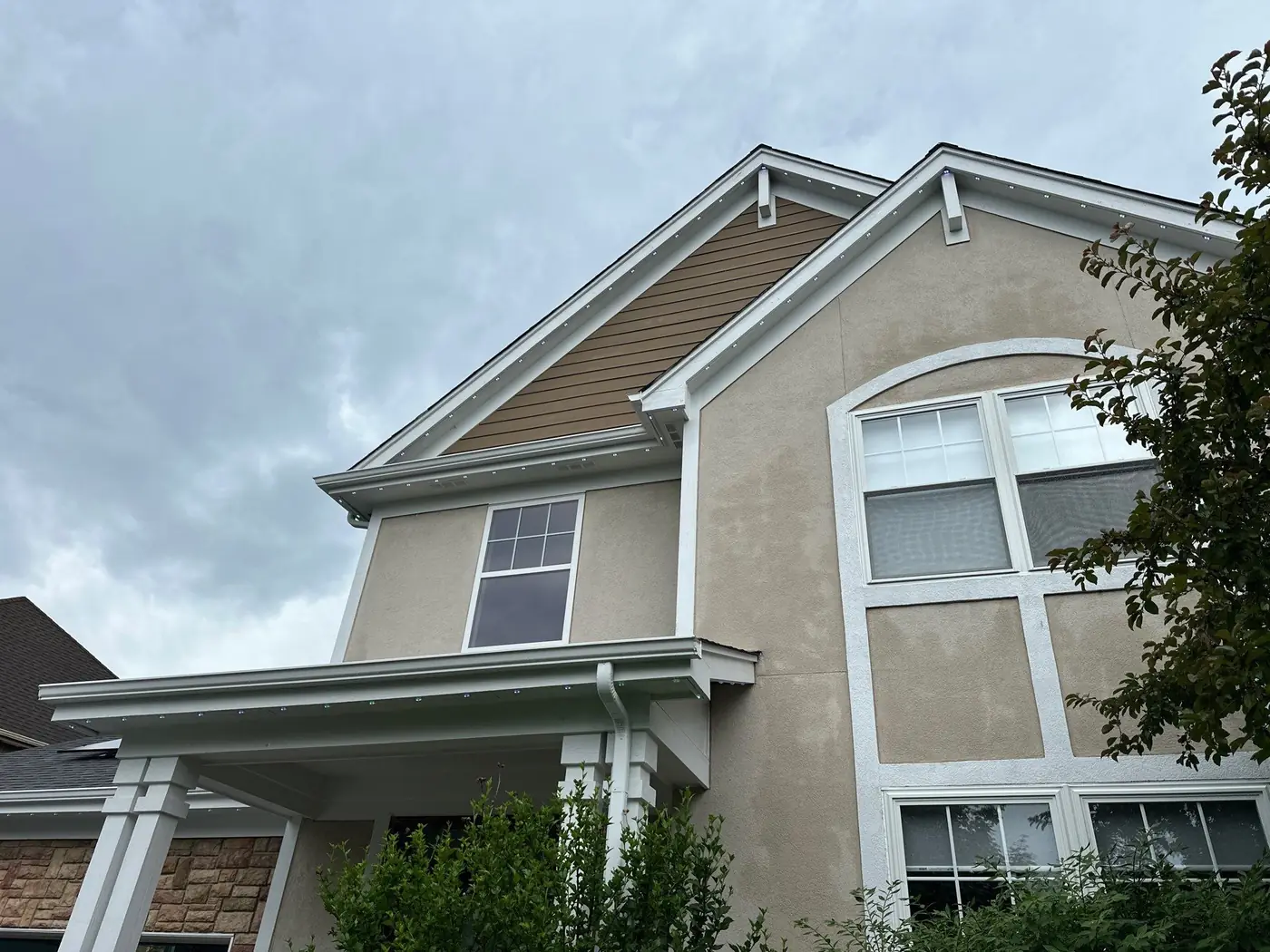
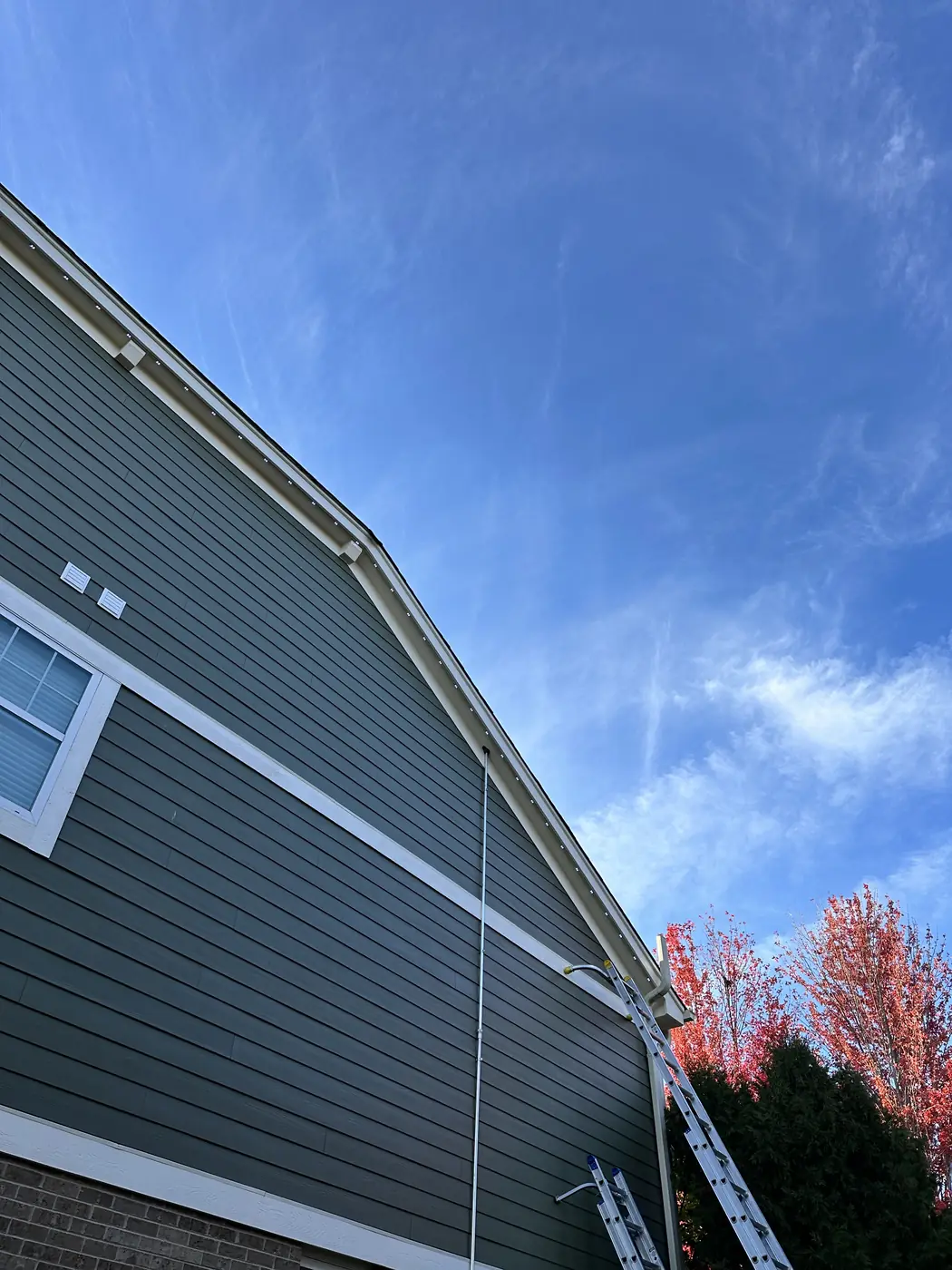
The lights are off most of the day. Track alignment, fastener spacing, wire concealment, profile, color match, corners, and transitions determine whether the system looks architectural or added-on. Ask for a daylight photo of a finished job, not only a nighttime video — we published real daylight photos of our own installs so you can see what the hardware actually looks like at noon.
Ten Questions to Ask Before You Buy
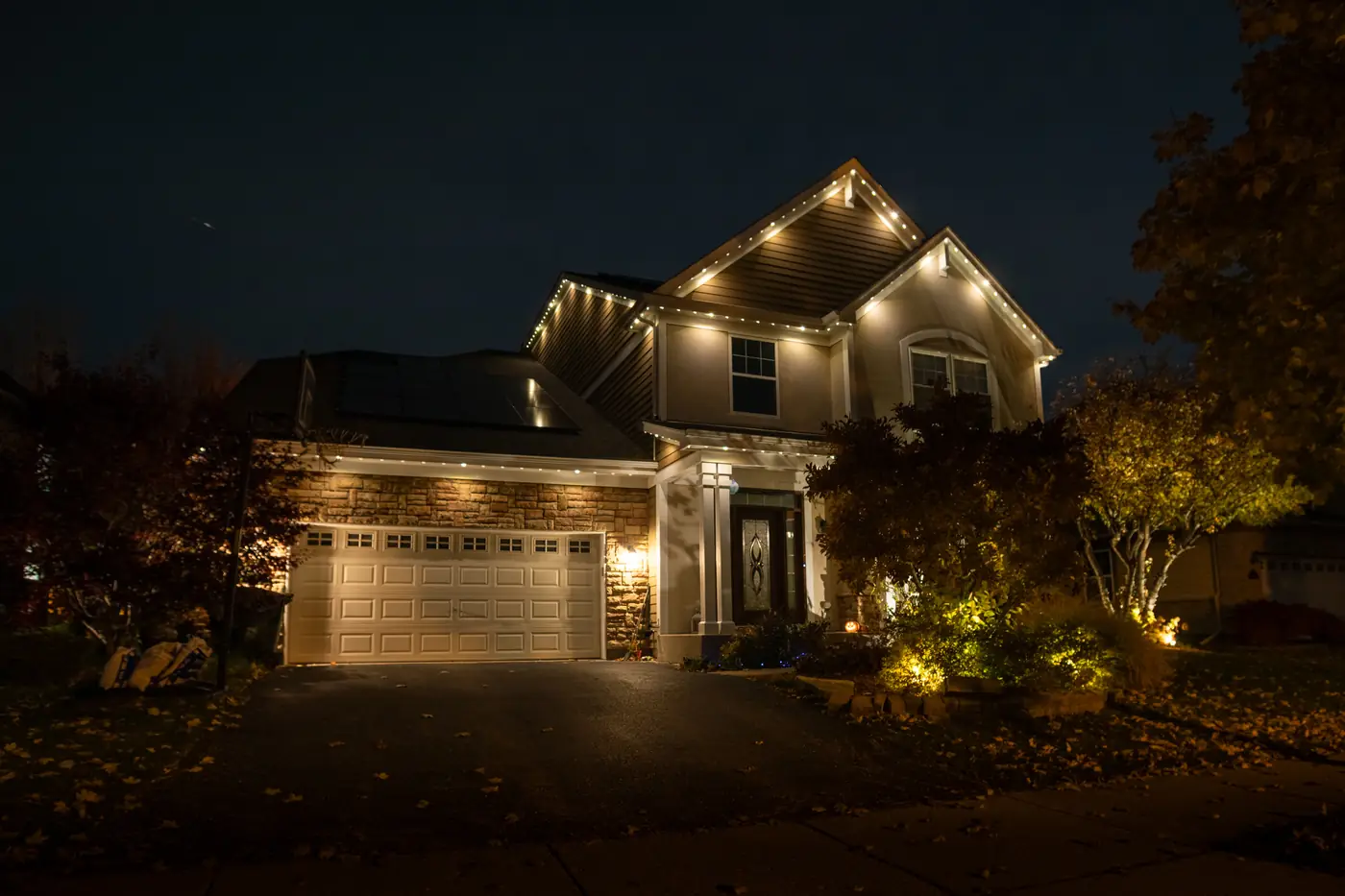
Our Recommendation
For a permanent, professionally finished installation, start by comparing Minleon and Gemstone Lights. Both belong in the premium tier, and they are strong in different places.
Choose based on the complete installation, not the longest feature list. Look at white light in person. Hold a track sample against the soffit during daylight. Ask how one failed light is repaired. Read the labor terms and the transfer clause. Make sure the installer is insured, mechanically fastens the system, conceals wiring, tests every zone, and will answer the phone later.
At Hanging Lights Club, we install Minleon because of what it lets us promise in Chicagoland: factory-terminated connections with no field splices, sections we can swap instead of rebuild, a redundant data line so one bad pixel does not take down your roofline, a dedicated white diode for the nights you just want the house to look good, and a 24-volt professional component ecosystem we stock and service ourselves.
Request a permanent-lighting assessment or call (224) 642-8018. We will review the roofline, show you the product and track in daylight, explain the service coverage, and provide a clear quote.
Sources and Disclosure
Hanging Lights Club installs Minleon permanent-lighting systems. This comparison was researched from manufacturer product pages, published technical data sheets, warranty documents, certification records, official app-store listings, and public dealer pricing, reviewed July 31, 2026. Where a manufacturer does not publish a specification, we said so rather than estimating. Installed prices vary by home and local provider. Product specifications and promotions can change.